Bowties to diamonds: 2026’s new marketing stack
Martech has evolved from warehouse-centric “hub-and-spoke” systems to ETL-driven “bowtie” stacks and now to middleware-powered “diamond” models, with the next shift likely toward AI agent–orchestrated, more fluid “constellation” architectures.


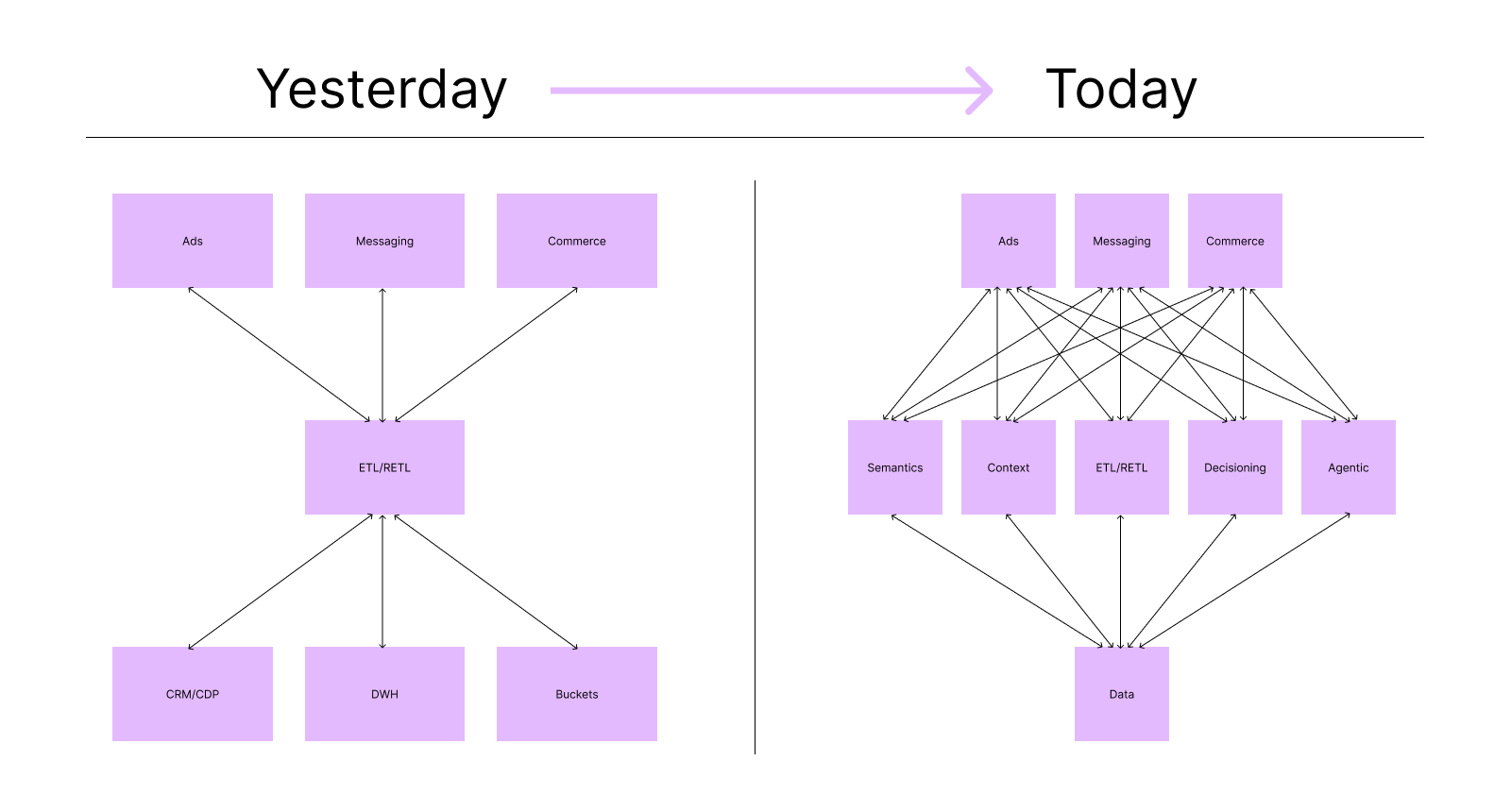
Something very interesting has happened with the overall topology of a cutting-edge brand’s martech stack. Over the past year or so the pattern I’m seeing among leading brands (including many of our own clients) is a shift from “bowtie”-style stacks, like you see at the left, to “diamonds” like on the right. Here’s how and why this revolution is underway.
The 2010s martech stack: Hub-and-spoke data warehouse models
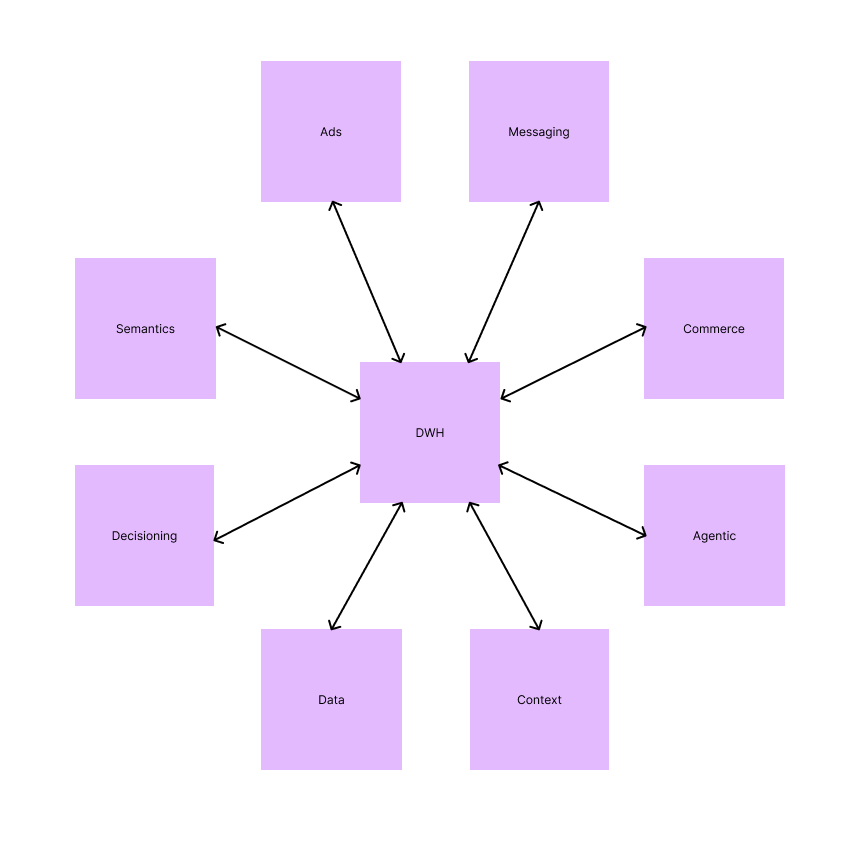
Throughout the 2010s it was fashionable (and useful) to imagine any technology-forward organization’s stack as a “hub and spoke” with the data warehouse in the middle. Every component would pull the data it needed from the warehouse and, in return, supply the warehouse with data that other components might need.
In practice this was never quite so easy. Not every software product a brand needed to actually engage its customers natively talked to the warehouse. Sometimes this was for straightforward reasons—it’s hard to build and maintain countless native connectors to every “source of truth” across every vertical—and other times the end product saw the warehouse as a threat: they wanted to own the workflow and the data.
The early 2020s: ETL tools and the bowtie marketing stack
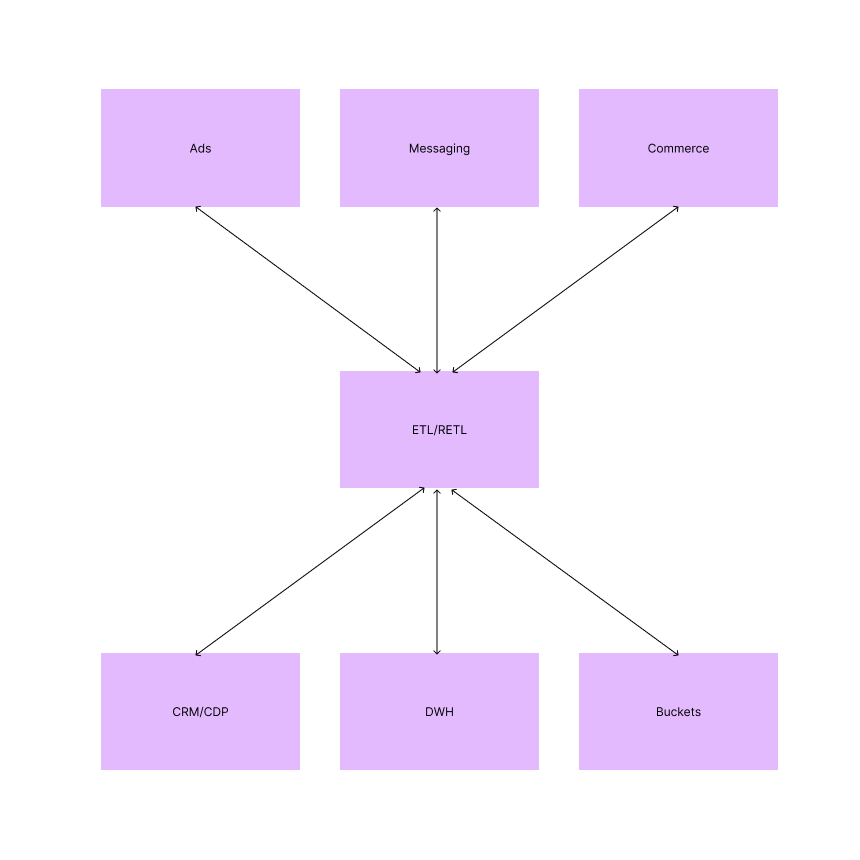
In the end, the market spoke, and robust Extract Transform and Load (ETL) tools like Fivetran became the crucial connector to feed data into the warehouse. Complementary Reverse ETL tools like Hightouch served the natural inverse role: delivering data from the warehouse back to the engagement tools marketers actually use.
It’s easy to see how central this ETL/RETL role became in the stack’s topology. So much so, in fact, that the “mental model” would often place it, rather than the warehouse itself, in the middle. That’s how we got the bowties of the early 2020s.
2026 martech stacks: Middleware and the diamond data model
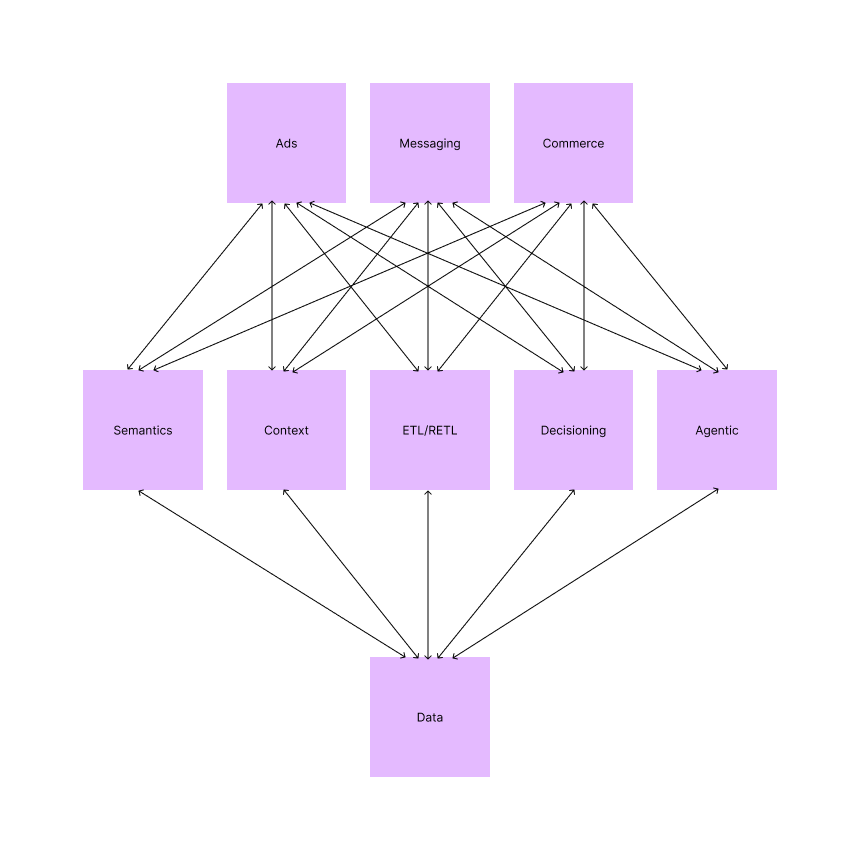
The centrality of the ETL/RETL position did not escape its occupants’ notice. In many cases it was the only tool with visibility on 100% of all of the organization’s data. The incumbent ETL/RETL vendors started to spread their wings, offering value-added services within this prime location—see Hightouch’s decisioning product and its latest agentic offering as examples. Other vendors like OfferFit (now a Braze product) sprung up in this “middleware” zone, leveraging data from the warehouse to orchestrate workflows within the engagement platforms.
Faraday, of course, thrives here as well, adding context to an organization’s data on its way to the engagement tools. Products like cube are starting to imagine the middleware zone itself as multi-layered, offering normalized semantics that make its neighbors’ jobs easier.
The “source of truth,” meanwhile, at the bottom of the diagram, has crystallized in my mind to a single point. As Scott Brinker so eloquently put it, once you “strip away the features, the interfaces, the proprietary data lock-in, the ecosystem lip service,” these systems essentially resolve to the same thing: the organization as represented by data.
The future of martech: AI agents and constellation structures
As the agentic paradigm deepens its hold on our industry, this diagram—already a far from perfect reflection of reality—will inevitably shift again. Where it goes is anyone’s guess, but I do believe it will be far less linear. Certainly agents will orchestrate everything, but I imagine their purview will extend beyond unidirectional customer engagement. A “constellation” structure is likely to emerge, with agents gathering data from every interaction and disseminating learnings throughout the stack.
The result may look eerily familiar — a modern recreation of the hub-and-spoke structure from a decade ago. Can’t wait to see where we go from there.
Andy Rossmeissl
Andy Rossmeissl is Faraday’s CEO and leads the product team in building the world’s leading context platform. An expert in the application of data analysis and machine learning to difficult business challenges, Andy has been running technology startups for almost 20 years. He attended Middlebury College and lives with his wife in Vermont where he lifts weights, makes music, and plays Magic: the Gathering.

Ready for easy AI?
Skip the ML struggle and focus on your downstream application. We have built-in demographic data so you can get started with just your PII.