Hi, we're Faraday.
Faraday is a customer context platform. We help consumer brands—as well as the technology companies, AI tools, and agencies that serve them—get the consumer data they need to engage every customer effectively.
1,400+
data points per consumer, including modeled, predictive data
240 million
U.S. consumers and their households
MCP/API
Agent-ready context
Built to solve a real problem
Faraday started with a simple problem: companies had plenty of data on what customers did, but almost no reliable way to know who those customers actually were. You could see the click. You couldn’t see the person behind it.
This gap has only gotten more pronounced as AI tools have become the norm. Agents and LLMs have incredible reasoning and analysis abilities but still don’t know anything about the person they’re talking to unless they’re provisioned with context. Faraday’s MCP and agentic-ready data make it an ideal tool to solve this problem for AI as well as consumer brands.
Tactically, Faraday closes this gap by solving three core problems for our clients: understanding who your best customers are, finding more people like them, and optimizing each marketing channel to engage them quicker and more efficiently.
Your data foundation
When you work with Faraday, you get more than a set of data about a consumer at one point in time — you get a cohesive data foundation you can build on with confidence, including a historical record of how each consumer has changed over time. Add it as a new field in your system of record, combine it with your first-party data to build propensity models, or feed it to your data science and AI teams for their in-house models.
That foundation is anchored on the Faraday Identity Graph, which contains 1,400+ attributes across three types of data:
- 1
Identity data
—verified names, emails, phones, and addresses, so your outreach actually reaches people.
- 2
Consumer profile data
—the information that tells your team and AI agents alike who they’re talking to, like demographics, financial signals, life stage, and lifestyle.
- 3
Custom predictive scores
—trained on your actual outcomes as well as the records within the Identity Graph.
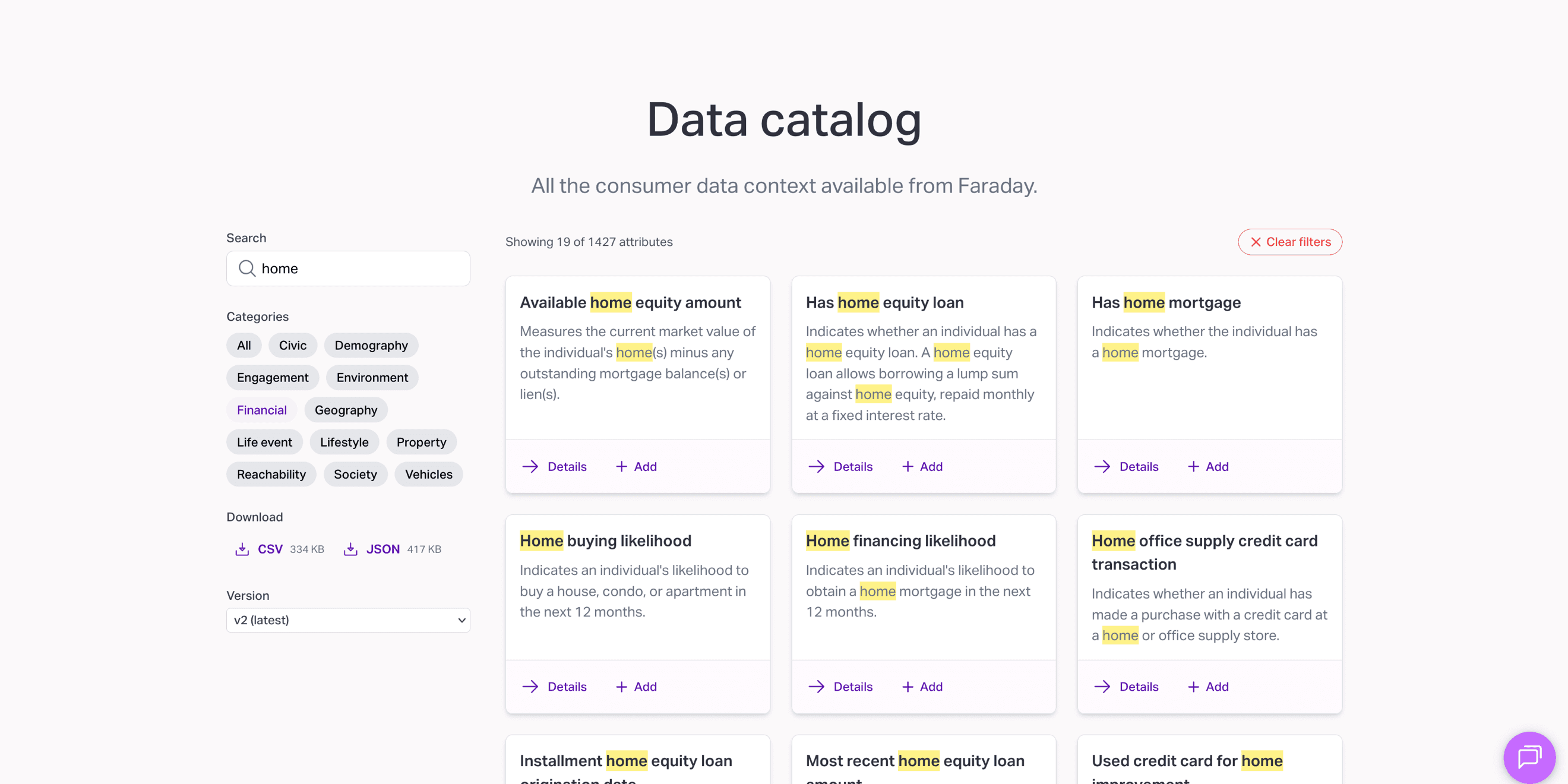
Want to see what’s inside? Browse the data catalog. And if you want to put it to work right away, Faraday Pro lets you buy data off the shelf.
Who we work with
We work with consumer brands, agencies, and the technology companies that serve them. Some partners receive consumer data or lead scores directly into their CRM to power marketing and sales operations, while others build our data into their own platforms or AI tools.
We also serve a range of verticals, including (but not limited to):
Leadership
FAQ
What is Faraday?
Faraday is a customer context platform. It was founded in 2012 and is headquartered in Burlington, Vermont.
We enable consumer brands, marketing agencies, and AI platforms access to quickly connect to a rich database of consumer data: the Faraday Identity Graph (FIG), which contains over 1,400 data points on approximately 240 million U.S. adults and their households. Faraday also has a unique ability to create custom data points by rapidly building predictive models that combine data from FIG with customers' unique first party data.
All our capabilities are available via API, MCP, or batch deployment directly into a client's existing tech stack, enabling more precise acquisition, personalization, and AI agents that are grounded in the real context of their consumers' lives.
What is a customer context platform?
A customer context platform combines, cleans, and synthesizes 1,400+ third-party consumer data points—including demographic, property, financial, and lifestyle data—into clear, actionable signals. These signals are then combined with your first-party data to power bespoke machine learning models, all of which are delivered seamlessly into your existing tech stack.
Most companies have first-party data but lack real-world visibility into their customers' wealth, life stage, intent, and other key factors. Platforms like Faraday close this gap by enriching customer records with the missing context, enabling both AI systems and human teams to reach and convert customers with greater precision.
Who founded Faraday and when?
Faraday was founded in 2012 by Andy Rossmeissl, Robbie Adler, and Seamus Abshere. Andy serves as CEO, Robbie as Chief Strategy Officer, and Seamus as Chief Technology Officer (and CISO). All three co-founders are still actively leading the company more than a decade later, alongside a leadership team that has grown to include heads of operations, customer experience, sales, and analytics. The continuity from founding through today is part of why Faraday has been able to build a deep, durable data and ML infrastructure rather than chasing trends.
Where is Faraday located?
Faraday is based in Vermont, with employees across the United States.
Who uses Faraday?
Faraday serves two primary types of customers:
Consumer brands use Faraday directly to enrich their customer data, build custom predictive models, and activate context across marketing, sales, and customer journeys. Primary verticals include home services (roofing, HVAC, solar, home renovation), financial services and insurance (banks, credit unions, debt consolidation, specialty insurance), and retail and e-commerce (jewelry, furniture, apparel, subscription boxes), along with health and wellness brands.
AI platforms, marketing agencies, and SaaS partners use Faraday as the data and ML infrastructure that powers consumer intelligence inside their own products. This includes agentic AI tools, vertical SaaS platforms, performance marketing agencies, and direct mail providers who embed Faraday's identity graph and predictive models into their own customer-facing offerings.
What industries does Faraday serve?
Faraday primarily serves consumer-facing industries where understanding individual customer behavior at scale drives measurable revenue outcomes. Core verticals include:
- Retail and e-commerce (e.g., jewelry, furniture, apparel, and subscription boxes)
- Home goods and home services (e.g., roofing, home renovation, HVAC, flooring, windows, and solar energy)
- Financial services and insurance (e.g., credit unions, banks, debt consolidation, and specialty insurance)
- Health and wellness (e.g., boutique fitness, nutritional supplements)
Faraday also provides the underlying data and ML infrastructure for partners to offer consumer data enrichment and predictive intelligence directly to their own users. Partner types include marketing agencies (e.g., performance marketing and direct mail providers) and SaaS and Agentic AI platforms (e.g., MarTech and vertical SaaS).
What does "Responsible AI" mean at Faraday?
Responsible AI at Faraday means building predictive systems that give brands real power without compromising on ethics, transparency, or fairness. In practice, that includes:
- Bias management: Built-in tools to detect and mitigate bias in predictive models across dimensions like age and gender.
- Explainability: Every prediction comes with explainability metadata showing what data contributed to that prediction.
- Transparent reporting: Bias reporting that quantifies model fairness across protected groups.
- Permissioned, ethical data sourcing: Faraday's consumer data is fully licensed from reputable vendors — never scraped, never derived from third-party cookies — and is never positioned for FCRA-regulated decisions like credit, employment, or housing.
Read more on our Responsible AI page.
How does Faraday ensure data is compliant and ethical?
Faraday has maintained SOC 2 Type II certification since 2020 and is fully compliant with HIPAA (BAA available), GDPR, CCPA, and 14+ additional U.S. state privacy laws. Key practices include:
- Strict isolation & encryption: Client data is logically isolated and encrypted at rest and in transit.
- Ethical sourcing: No third-party cookies, no social scraping, never positioned for FCRA-regulated decisions.
- Continuous auditing: NIST 800-53 risk management, HackerOne penetration testing, and Checkr employee background checks.
How does Faraday differ from lead scoring tools and analytics & modeling platforms?
Most lead scoring and modeling tools work from the same limited foundation: 1st party signals collected by the brand itself like clicks, form fills, and CRM activity. Faraday adds a layer those tools can't replicate—combining that 1st party data with real-world consumer signals like life stage, financial capacity, and household context, then delivering configurable predictions directly into the tools and workflows where decisions get made.
| Dimension | Faraday | Typical prediction tools |
|---|---|---|
| Approach | Full customer context layer (identity + real-world data + predictions) | Individual scores (e.g., lead score, churn score) |
| Data foundation | Combines first-party data with real-world signals like life stage, financial capacity, and household context | Primarily first-party behavioral data (clicks, purchases, engagement) |
| Explainability & usability | Transparent, explainable data points that show why a prediction exists | Limited visibility into how scores are generated |
| Activation & integration | Delivered directly into CRMs, warehouses, and APIs for use across the full funnel, including support for real-time and agentic workflows via MCP | Often confined to a specific tool or workflow |
How does Faraday differ from a CDP?
A Customer Data Platform (CDP) manages data pipelines, while Faraday provides the intelligence that populates them. They are complementary tools with distinct roles:
- CDPs: Organize your internal first-party data to track how customers have already interacted with your brand.
- Faraday: Acts as the intelligence engine, enriching your CDP with real-world customer context—like wealth, life stages, and predictive scores.
Faraday does not replace your CDP; it provides the grounded context that makes your CDP data actionable.
Is Faraday an AI platform? How is it different from an LLM like ChatGPT?
Faraday is not an LLM like ChatGPT. LLMs generate responses based on patterns in text, but they don't know who they're talking to or retain persistent context about real people.
Faraday provides that missing layer of context. Using machine learning, we generate predictive data — who is likely to convert, churn, or respond — and deliver it directly into your tech stack so your systems understand who a person is, what motivates them, and how likely they are to act.
LLMs generate outputs; Faraday ensures those outputs are grounded in the actual reality of the people they're talking to.