All blog posts
Product
How data enrichment actually works with Faraday, and what data you can find
Faraday's data enrichment appends verified third-party data points from FIG to your customer records, filling contact gaps, deepening customer understanding, and powering smarter targeting and expansion decisions.



Andy Rossmeissl &
Robin Spencer
on
Updated: May 2026
In our last post, we made the case that B2C brands are leaving value on the table because the data they have about their customers isn't complete enough to act on. Brands know what customers bought. They have a name, probably an email address and physical address. What they’re missing is the broader context — who the customers actually are, what their financial situation looks like, where they are in life — and that's exactly what's missing when campaigns underperform and outreach falls flat.
The first step to closing that gap is data enrichment: appending verified, high-quality external data points to your existing customer records so you're working with a complete picture instead of a partial one. That's what Faraday can do for your brand, and this post covers what data is available, how the enrichment process works, and how to get started.
What data is available for enrichment through Faraday
Faraday's data enrichment is powered by the Faraday Identity Graph (FIG) — a comprehensive, continuously maintained dataset covering 240M US consumers and their household, with over 1,400 verified, pre-cleaned, and feature-engineered data points. Every record is tied to a verified consumer identity, which means the data you enrich actually belongs to the person you're trying to reach.
FIG’s data points cover a range of categories including:
- Demographics — age, gender, household income, education level, marital status
- Property and housing — homeownership status, home value, roof type, garage spaces, length of residence
- Financial signals — Credit Score Proxy, spending percentiles, investment behavior, debt indicators
- Life events — recent move, new homeowner, new parent, marriage, retirement
- Lifestyle and interests — hobbies, brand affinities, vehicle ownership, charitable giving patterns
- Contact and identity — verified name, address, email, phone, household composition
We recently completed a major refresh of the entire FIG catalog as part of FIG v2, updating data points across every category. You can browse everything that's available at faraday.ai/catalog or purchase data directly at Faraday Pro.
How data enrichment actually works
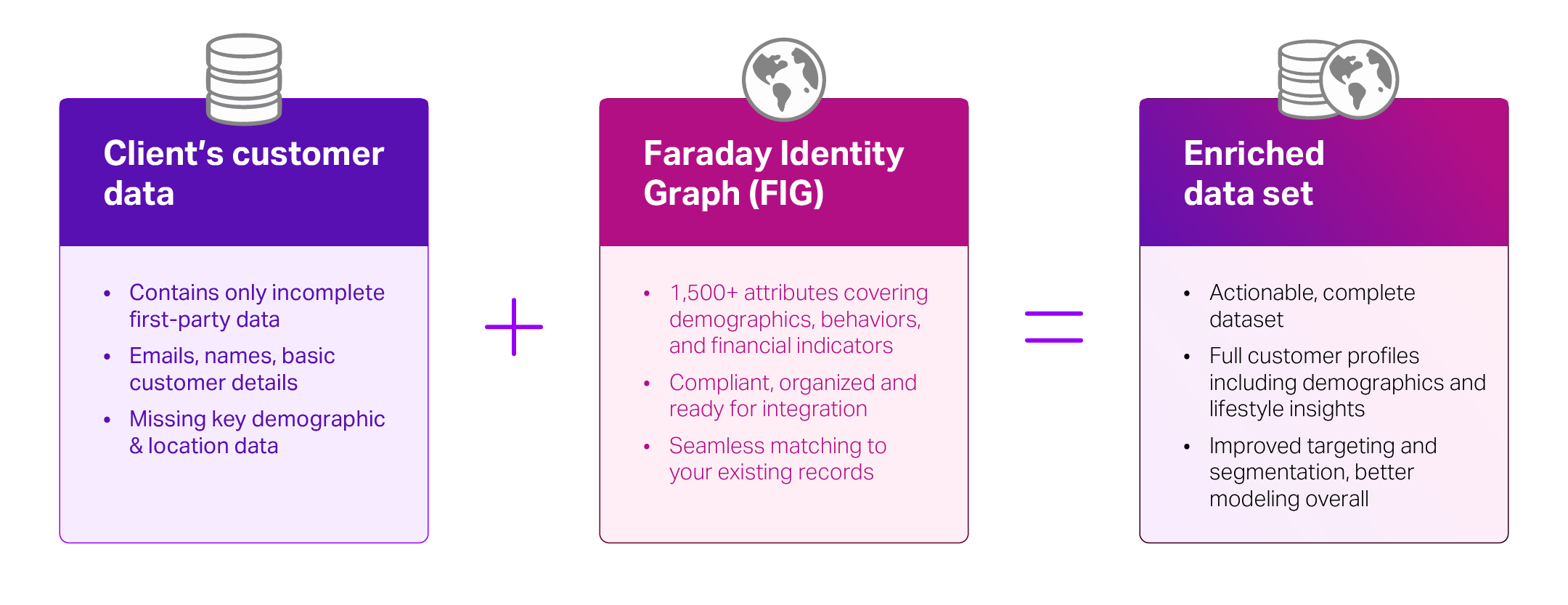
A data enrichment is the process of matching your existing customer records to FIG and appending the data points you select. The process is straightforward:
-
Select your data points. Choose the specific attributes that address your business question — whether that's segmenting your audience, scoring leads, expanding into direct mail, or understanding your ICP. You can select individual fields or use one of Faraday's pre-built essentials packages, curated by vertical for home services, retail and ecommerce, and financial services.
-
Match against FIG. Faraday resolves your customer records to verified identities in FIG using a combination of name, email, phone, and address fields. This is deterministic matching — not probabilistic — so you can trust the appended data actually maps to the right person.
-
Receive enriched records. Your data comes back in a clean, structured format ready to load into your CRM, CDP, data warehouse, ad platform, or wherever you need it.
How brands use data enrichment
Data enrichment can unlock your entire marketing strategy — better segmentation, smarter messaging, new channels you couldn't reach before. But here are the three ways we see brands put it to work first:
Fill contact gaps to expand your reach. A brand that's built its entire customer relationship through email has email addresses — but no physical addresses, no phone numbers. If they want to run direct mail or a call center program, enrichment is what makes that possible. You get the missing contact fields enriched to records you already own.
Understand your customers beyond the transaction. Your purchase history tells you what people bought. It doesn't tell you who they are — their financial situation, life stage, household context, or what else they might be in the market for. Enrichment fills that picture in so your segmentation and messaging are based on something real.
Research your market before you move into it. If you're evaluating a new geography, a new channel, or a new customer segment, enrichment lets you analyze the landscape before you commit — understanding what the population looks like and where the opportunity actually is.
Why not just find the data yourself?
Some companies attempt to enhance their marketing efforts by purchasing third-party data directly from various vendors themselves, rather than using packaged and processed services like Faraday’s data enrichment. However, this approach often presents significant challenges:
Contracting complexity: Sourcing offline data can involve lengthy negotiations and large upfront commitments.
Security risks: Handling sensitive data requires strict compliance frameworks, such as SOC-2 certification. Unlike many vendors, all Faraday data enrichment is privacy-compliant, ethically sourced, and adhere to high standards of data protection, ensuring your customers' personal information remains secure while providing actionable insights.
Regulatory challenges: Companies storing offline data must navigate consumer privacy laws, including opt-out and deletion requests. Faraday manages these complexities for you, so you can focus on what matters—leveraging new insights to drive revenue.
Data science overhead: Raw offline data often requires significant processing, feature selection, and bias mitigation before it can be effectively used. This can result in costly time and resource investments as companies try to integrate third-party data into their models.
Faraday handles all of this before the data reaches you. The trade-off isn't 'Faraday or DIY' — it's spend your team's time building and maintaining data infrastructure, or spend it running better campaigns.
How to get started
Getting started with Faraday’s data enrichment is simple. Once you’ve identified the data points you need, we’ll work with you to integrate them into your existing systems. Whether you’re looking for a one-time data boost or ongoing data enrichment, our flexible pricing and easy integration make it simple to scale.
If you're not sure where to start, browse what's available at our new data catalog — or talk to a context consultant who can help you identify which data points are most likely to move the needle for your specific business before you commit to anything.
And if you just want the data today, you can find it yourself in our new self service marketplace.
Andy Rossmeissl
Andy Rossmeissl is Faraday’s CEO and leads the product team in building the world’s leading context platform. An expert in the application of data analysis and machine learning to difficult business challenges, Andy has been running technology startups for almost 20 years. He attended Middlebury College and lives with his wife in Vermont where he lifts weights, makes music, and plays Magic: the Gathering.
Robin Spencer
Robin Spencer is Faraday’s COO, leading all of our client-facing teams—from sales to customer success. Her mission is simple: help consumer businesses uncover where data can meaningfully improve (and profitably accelerate) the customer journey. Robin brings experience from Accenture, Google, and Clearbit (acquired by HubSpot), where she focused on using data to drive real, measurable business outcomes. When she’s not geeking out about data and operational strategy, you’ll find her tending her cut-flower garden, knee-deep in a creative project, or wandering in the woods nearby.

Ready for easy AI?
Skip the ML struggle and focus on your downstream application. We have built-in demographic data so you can get started with just your PII.