How pixel providers unlock consumer context for AI agents
AI agents need consumer context to personalize, but most website visitors are anonymous. Pixel providers resolve anonymous traffic to known identities -- and Faraday enriches those identities with 1,400+ attributes and predictive scores so agents can deliver real-time, personalized experiences.


See our complete guide: Powered by Faraday — embedding predictive AI in your platform.
AI agents are reshaping how brands interact with consumers. Shopping assistants, recommendation engines, agentic marketing tools—all of them promise to deliver personalized experiences at scale. But there's a fundamental problem: personalization requires context, and context requires identity. For the vast majority of your website traffic, you have neither.
Roughly 95% of website visitors are effectively anonymous. Safari's Intelligent Tracking Prevention, Firefox's Enhanced Tracking Protection, Chrome's evolving privacy restrictions, widespread ad blocker adoption, and incognito browsing have collectively dismantled the cookie-based identity model that personalization has historically relied on. Without cookies, there's no persistent identifier. Without an identifier, your agent has no idea who it's talking to—and falls back to the same generic experience it would serve anyone else.
This is the bottleneck for personalized agentic experiences. It doesn't matter how sophisticated your agent is if it has zero context about the person it's serving. The agent needs to know something about the visitor—what they're likely interested in, how price-sensitive they are, whether they're a first-time browser or a high-intent buyer—and right now, for almost all of your traffic, it knows nothing.
Pixel providers: resolving anonymous visitors
A growing category of tools—often called pixel providers—directly addresses this gap. The concept is straightforward: you install a lightweight JavaScript snippet in your site's <head>, typically via Google Tag Manager or a platform-specific integration like a Shopify app. The pixel fires on every page load and resolves anonymous visitors to a known identity—email address, name, mailing address—using a combination of device fingerprinting, IP intelligence, and the provider's own identity graph.
Numerous providers operate in this space (reach out to ask about our recommended partners), each with their own identity graph and installation flow. The specific mechanics vary—some offer configurable collection rules to filter for high-intent visitors before resolution, others resolve on every page view—but the output is the same: a resolved identity record delivered to your systems via webhook, API, or warehouse sync.
Adding consumer context with Faraday
A resolved identity is a critical first step, but an email address alone doesn't tell your agent much. To truly personalize, you need rich consumer context: demographic and lifestyle attributes, purchase propensities, persona classifications, predicted next-best-offer. This is where Faraday comes in. Faraday takes the resolved identity from your pixel provider and enriches it against the Faraday Identity Graph—returning 1,400+ consumer attributes alongside custom predictive scores you've configured (propensity to convert, persona membership, cohort affinity, and more) via the Lookup API.
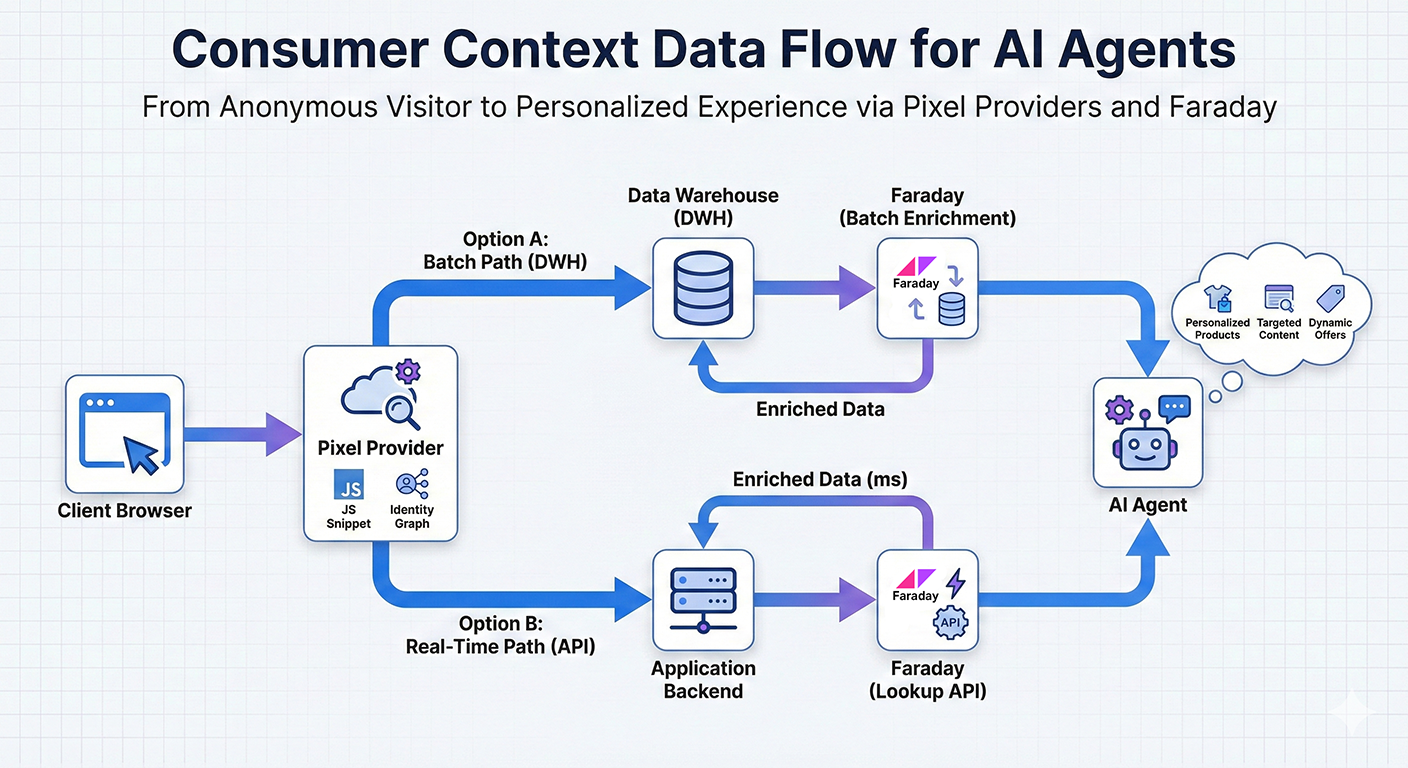 Batch and real-time workflows are both available
The combination of pixel-based identity resolution and Faraday's consumer context enrichment creates a complete pipeline: anonymous visitor → known identity → rich, actionable context → personalized agentic experience.
Option A: batch enrichment
The batch path is ideal when you're running scheduled enrichment, building audiences, or doing offline analysis.
Your pixel provider delivers identified visitor records—email, name, address—to your data warehouse (Snowflake, BigQuery, Redshift, Postgres, S3, or similar). You connect that warehouse to Faraday as a data source. Faraday resolves the identities against FIG, enriches each record with consumer attributes and predictive scores, and deploys the results back to your warehouse or to downstream systems via managed connections.
From there, your agent applications query the enriched data directly from the warehouse. Because the enrichment happens on a schedule, this patyh works well for use cases where near-real-time isn't critical: bulk audience segmentation, periodic model retraining, cohort-level analysis, and offline campaign planning.
Option B: real-time enrichment
The real-time path is where things get interesting for agentic experiences that need to personalize on the fly.
The pixel fires on page load, and the provider resolves the visitor to a known identity in real time—typically within seconds of the page rendering. Your application backend immediately calls Faraday's Lookup API (POST /v1/targets/{target_id}/lookup) with the resolved PII (email, address, phone + last name, or any combination). Faraday returns the full enrichment payload—propensity percentiles, persona classifications, cohort membership, FIG attributes—in milliseconds.
Your agent now has everything it needs. A shopping assistant can recommend products based on predicted category affinity. A retention tool can calibrate discount depth based on price sensitivity scores. An agentic marketing platform can select the optimal channel and message for a given persona. All of this happens while the visitor is still on the page, transforming what would have been a generic interaction into a contextually rich, personalized experience.
Getting started
To get this workflow started, reach out and talk to sales. Or, if you'd like to get moving immediately, you can sign up for Faraday. Our documentation covers the full setup for both batch and real-time integration paths.
Seamus Abshere
Seamus Abshere is Faraday’s Co-founder and CTO (and serves as CISO), leading the technical vision behind the company’s consumer modeling platform. At Faraday, he focuses on building an API for consumer modeling and the infrastructure that helps customers turn first-party data into more actionable predictions. Before Faraday, Seamus was an Engineering Director at Brighter Planet. He studied Anthropology and Computer Science at Princeton University and is based in Burlington, Vermont.

Ready for easy AI?
Skip the ML struggle and focus on your downstream application. We have built-in demographic data so you can get started with just your PII.