Who are your customers, really? Find out with a Faraday Insights Report
An Insights Report combines Faraday's persona analysis and market opportunity analysis into one report, built around the questions you need answered before your next big decision.


The end of the year is coming, and with it, planning season. Budgets get set, channels get picked, and targets get handed down. Every one of those decisions rests on an assumption about who your customers are and where you'll find more of them.
So before you lock anything in, ask yourself: can you really plan if you don't truly know your audience?
Most teams know a lot about how people interact with their brand. They know who clicked, who visited, and who bought. What they often don't know is who those people are: their life stage, their household, their finances, and what sets them apart from the people who didn't buy. That's the context gap, and it matters most when the stakes are highest.
When teams run into that gap at planning time, the usual options aren't complete. Go with gut feel. Settle an internal debate about which segment matters most. Or bring in a consulting firm, which can cost six figures and often takes longer than you'd hoped.
An Insights Report from Faraday is a different option: answers built on real data, delivered in less than one week, not after weeks or even months of lead time.
What an Insights Report is
It brings together two things Faraday already does: persona analysis and market opportunity analysis. Persona analysis tells you who your best customers are by grouping them into distinct, data-driven profiles. Market opportunity analysis tells you how many more people like them are out there, and where. Together, they answer the question behind most planning: who should we be going after, and how big is the opportunity?
We start with the two or three questions that matter most to you. Common ones are "Who are our best customers?", "Why do some leads convert and others don't?", and "What's our penetration by market?" Then we match your customer records to the Faraday Identity Graph, which covers 1,400+ data points on 240+ million US consumers and their households. Your records show you who bought. Faraday's data shows you all the details behind that purchase: who those people actually are.
The report connects and compares the two, using the same data and back-end systems that power the rest of the Faraday platform (not an LLM guessing from a prompt and limited context). The result is one report that shows who your best customers are, what sets them apart, and how many more people like them you can still reach.
Using an Insights Report to plan
For most marketers, planning boils down to a handful of critical decisions: who to target, how to reach them, what to say, and where to put the budget.
An Insights Report gives you context for each one:
Who your best customers are
Most customer bases aren't a single audience. When we group a client's best customers into personas, they often split into several distinct profiles that need different creative and different media. Knowing that before you plan means you can build for each group instead of averaging across them.
Who converts, and who doesn't
Comparing people who bought with people who engaged but didn't is often where the most useful findings come from. Sometimes the two groups look nearly identical on the surface, and the difference only shows up in one or two specific traits. Those traits are what you can target, score, and act on.
How much opportunity is left
Once you know who your best customers are, you can see how many more people like them exist and where they live. That tells you whether a market deserves more spend, or whether you've already reached most of it.
Which channels and messages fit
Personas carry more than demographics. They show how people tend to shop, whether they respond to mail, and what they care about. That gives you a starting point for channel mix and messaging before you spend a dollar testing it.
It's not just for end-of-year planning
And while planning season is a natural time for this kind of analysis, it isn't the only one.
Take a new CMO a few weeks into the job. They've inherited a strategy, a budget, and a set of segments someone else built. They need to know whether those segments hold up, and they need to know before their first big decision. This analysis gives them a data-driven read on the customer base in their first 90 days, so they can keep what works and change what doesn't.
The same goes for any moment when a big question comes up: entering a new market, launching a product line, rethinking how you buy leads, or settling a debate about who your best customers are. If the answer depends on knowing who your customers are, an Insights Report is built for it.
Another way to get these insights
If you'd rather explore the data yourself, Ask Faraday lets you ask questions about your customers in plain language, in whatever LLM you already use. But it isn't the same as "asking ChatGPT." Ask Faraday's answers are backed by Faraday's data, not a hallucination or a guess. It's the same data our enterprise predictive models are built on, piped directly into your LLM. With it, you can see how your customers compare with your markets or with the US as a whole, without building the analysis yourself.
No two Insights Reports look alike
Every report starts from your questions, so every report looks different. Here are a few examples, with details left out to keep our clients anonymous.
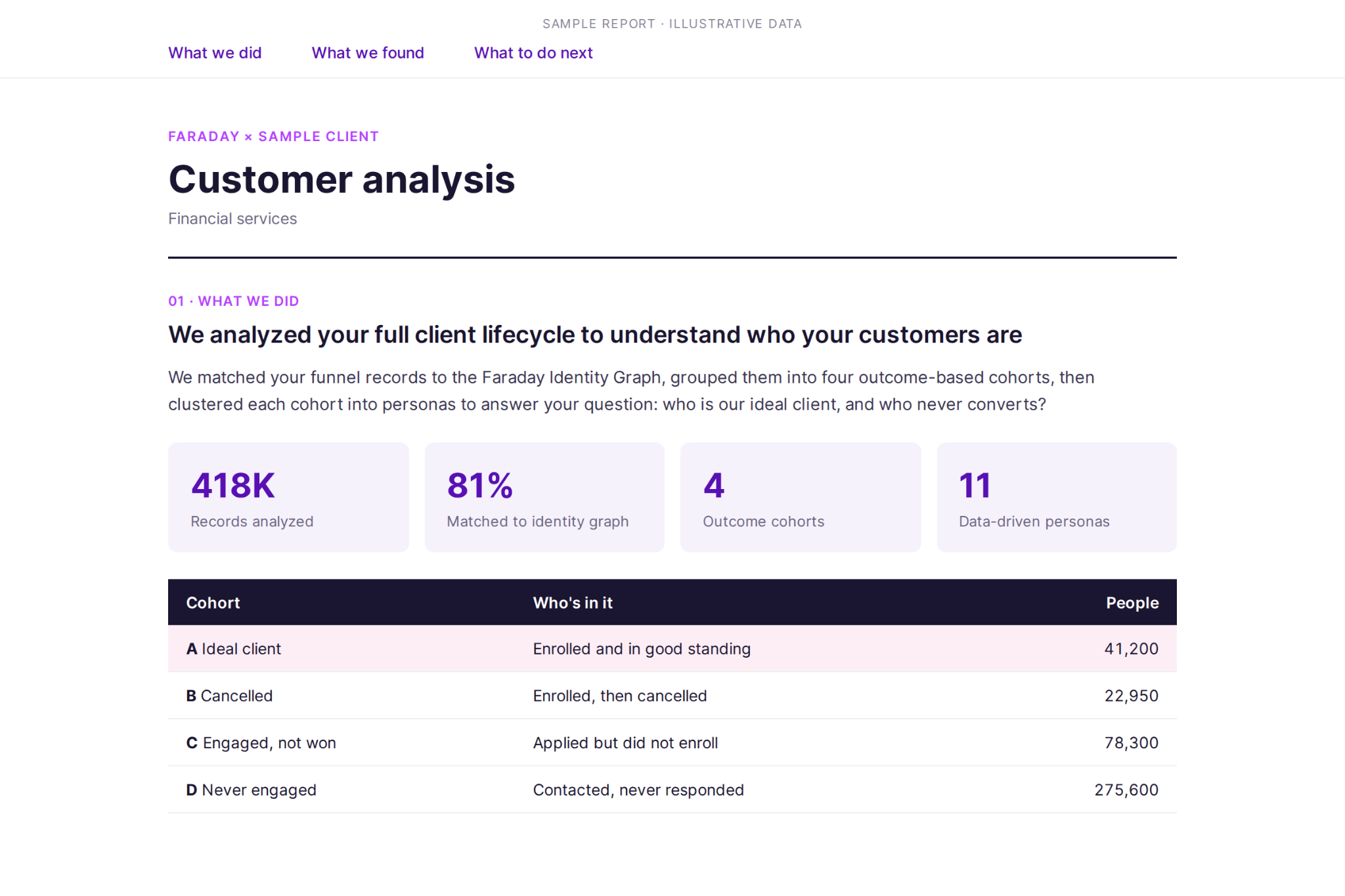
A financial services company wanted to understand why some leads enrolled while others engaged and then walked away. We analyzed their full funnel, from people who never responded to long-standing clients, and grouped each stage into personas. Their best clients turned out to be three distinct profiles, each reached through a different channel. The clearest difference between people who enrolled and people who didn't came down to a single financial trait, a signal they can build directly into how they score leads. They got the report along with the underlying data, so their own team could keep working with it.
Sample report with illustrative data.
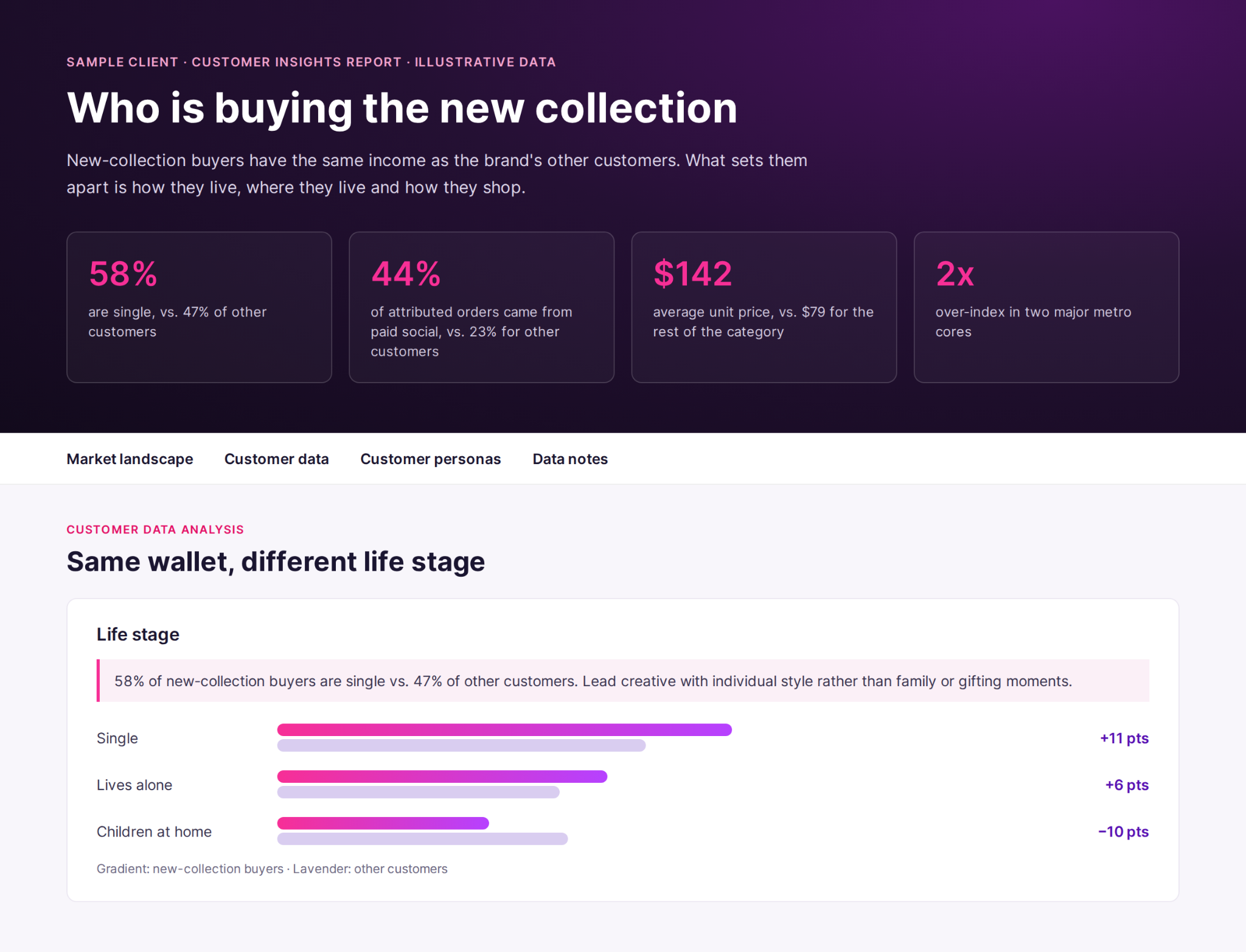
An online apparel brand had launched a new product line and wanted to know who was buying it. We compared those buyers with the brand's other customers and looked at where the line fit in the broader market. The new buyers earned about the same as everyone else. What set them apart was their life stage, where they lived, and how they found the brand. That pointed to a clear plan: target on life stage rather than income, concentrate spend in the metro areas where buyers clustered, and hold the price.
Sample report with illustrative data.
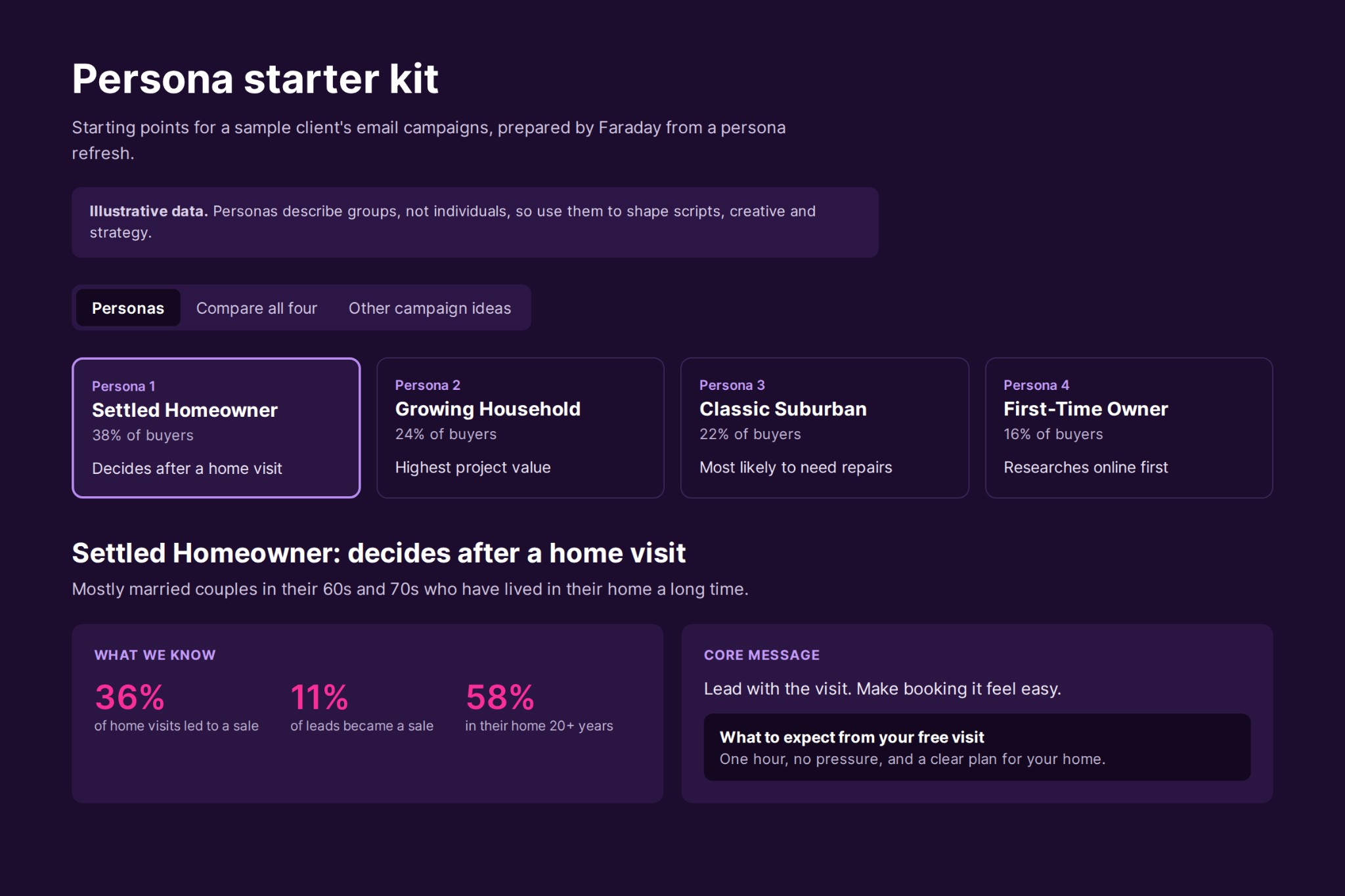
A home improvement company wanted to turn its personas into campaigns. Their report became a persona starter kit. For each persona, it covered what the data shows, how to personalize, a core message, sample subject lines, the tone to aim for and avoid, and three tests to run first. It reads more like a campaign brief than an analysis.
Sample report with illustrative data.
Yours will look different, because your questions are different.
Get started
Planning season is already here. Talk to a context consultant about an Insights Report, and go into next year knowing who your customers actually are.
FAQ
What data do I need to provide?
Your customer records, at minimum. The more of your funnel you can share, such as who converted, who engaged but didn't, and who never responded, the more questions the report can answer. Faraday matches those records to the Faraday Identity Graph and adds the context.
How long does it take?
It depends on your questions and how quickly your data is ready. Once your data is in, the analysis can come together in days, not months.
Is an Insights Report the same as Faraday Enterprise?
No. It's a focused engagement built around a few specific questions. From there, teams typically move into an Enterprise plan to put what they learned to work. Others find the report shows them exactly which data points they need, and they go straight to Faraday Pro.
Robin Spencer
Robin Spencer is Faraday’s COO, leading all of our client-facing teams—from sales to customer success. Her mission is simple: help consumer businesses uncover where data can meaningfully improve (and profitably accelerate) the customer journey. Robin brings experience from Accenture, Google, and Clearbit (acquired by HubSpot), where she focused on using data to drive real, measurable business outcomes. When she’s not geeking out about data and operational strategy, you’ll find her tending her cut-flower garden, knee-deep in a creative project, or wandering in the woods nearby.

Ready for easy AI?
Skip the ML struggle and focus on your downstream application. We have built-in demographic data so you can get started with just your PII.